
Article: What We Choose to Keep
What We Choose to Keep
On restoration, material memory and the objects that outlive us
I’m in Prague reading Jiří Weil's Mendelssohn Is on the Roof.
The book opens with an order to remove the statue of Felix Mendelssohn from the roof of the Rudolfinum. Mendelssohn was born into a Jewish family, and under Nazi occupation even his stone likeness had become unacceptable. The men charged with removing him don't know which statue he is. Using the grotesque logic of Nazi racial theory of a big nose to identify him, they nearly pull down Wagner instead.
It's absurd. And then it isn't.
Weil keeps returning to people and stone. People disappear while buildings remain. Statues remain, or not. The physical city survives the human beings who once inhabited it.
I couldn't stop thinking about that this morning while antiquing in Prague. Looking at old jewelry, silver and domestic objects, I found myself asking a question that normally is a passtime: Who owned this? Here, the question felt different.
Prague was occupied by Nazi Germany from 1938 to 1945. Its Jewish population was systematically dispossessed before being deported. Apartments were emptied. Personal property was catalogued, warehoused and redistributed. So standing in front of an anonymous old object in antique shops and markets, another question entered my mind: How did this get here? An old object can arrive in a shop through a hundred perfectly ordinary histories… inheritance, sale, estate, collection, another dealer. But in Prague, provenance has a shadow.
And once I started thinking about it, I couldn't quite stop.

STOLPERSTEINE (“STUMBLING STONES”) IN PRAGUE. SMALL BRASS PLAQUES EMBEDDED OUTSIDE THE LAST FREELY CHOSEN HOMES OF PEOPLE PERSECUTED BY THE NAZIS. PART OF THE WORLD’S LARGEST DECENTRALIZED MEMORIAL, EACH ONE RETURNS A NAME TO AN ADDRESS, A SMALL PIECE OF METAL ENSURING THAT WHILE THE CITY REMAINS, THE PERSON IS NOT FORGOTTEN. PHOTO: ©ALLOYALIST
Later that day I went to the Museum of Decorative Arts. The exhibition currently running there is called Vita Aeterna: Eternal Life, and it is devoted to conservation and restoration. Its premise is beautiful: cultural objects don't survive by themselves. Materials deteriorate, and conservators stand between the object and its disappearance. The museum describes restoration as the largely invisible work connecting past and future. I loved this immediately.
And then I realized there was a problem with the idea I had been forming all day. I had been thinking: Objects survive because someone chooses to keep them. But that isn't always true. Keeping implies choice. And history is full of objects whose survival had very little to do with the choices of the people who made or owned them.

The Museum of Decorative Arts has worked with the Documentation Centre for Property Transfers of Cultural Assets of WWII Victims to research objects in its collections that originally belonged to Jewish victims of Nazi persecution. Their research identified several hundred objects, in some cases tracing them back to individual owners through the transport numbers assigned when those owners were deported. For those interested, that history has been documented in Memories Returned: Jewish Property at the Museum of Decorative Arts, Prague, by Helena Krejčová and Mario Vlček. It is worth reading alongside any discussion of what it means for an object to “survive.” But I digress...
The beautiful thing about Vita Aeterna is that it shows the work required to carry material forward. And perhaps that's where my original thought still holds, but in a different way: We may not get to choose what survives history. But once something reaches our hands, we do have a choice about what happens to it next.
The museum contains other, much older kinds of survival. I kept returning to carved stone. This early seventeenth-century footed bowl is attributed to Ottavio Miseroni, part of the celebrated family of hardstone cutters associated with the court of Rudolf II in Prague. Its materials - jasper and heliotrope - have already existed on a geological timescale almost impossible to comprehend.

CARVED JASPER AND HELIOTROPE FOOTED BOWL BY OTTAVIO MISERONI, EARLY 17TH CENTURY, PRAGUE. MISERONI WAS PART OF THE CELEBRATED MILANESE GEM-CUTTING FAMILY THAT ESTABLISHED WORKSHOPS IN PRAGUE UNDER RUDOLF II, HELPING MAKE THE CITY A CENTER FOR VIRTUOSO HARDSTONE CARVING. MUSEUM OF DECORATIVE ARTS IN PRAGUE. PHOTO: @ALLOYALIST
The maker shaped them.
The maker disappeared.
The object continued.
And even the object wasn't fixed in time: its foot was added centuries later.
What, then, is the "original" object?
The stone?
Miseroni's carving?
The later mounting?
Its restoration?
Its present life inside a museum?
As a maker, the restoration tools interested me almost as much as the objects. Tweezers. Pliers. Brushes. Blades. Drawings. Adhesives. They looked familiar. Making and conserving require many of the same gestures, but their intentions are different. One brings an object into existence. The other negotiates how much of that existence should remain. And that distinction matters.

TIMEKEEPING, TABLEWARE AND PRECIOUS METAL TRANSFORMED INTO MINIATURE WORKS OF ARCHITECTURE. PAINTED ORNAMENT, REPOUSSÉ, CHASING, ENGRAVING AND SCULPTURAL RELIEF REVEAL THE ASTONISHING RANGE OF DECORATIVE CRAFTSMANSHIP PRESERVED AT THE MUSEUM OF DECORATIVE ARTS IN PRAGUE. PHOTO: @ALLOYALIST
Metal makes this particularly visible. Metal can be melted. That makes its survival rather miraculous. Gold has been melted, alloyed, hammered, drawn, cast, chased, worn down, repaired and melted again for thousands of years. The material can survive while the object disappears completely. As a metalsmith, I find something both beautiful and unsettling about that. We talk about precious metals as permanent, but they aren't. The metal is permanent but the object is contingent. For an object to remain an object, generation after generation has to refrain from turning it into something else.

AN EXTRAORDINARY STUDY IN ORNAMENT, CHASING & REPOUSSÉ, AND THE TRANSFORMATION OF METAL INTO NARRATIVE FORM. PHOTO: @ALLOYALIST
Even though I sometimes melt a piece with poor craftsmanship and design, I still believe in keeping things. Probably more than ever. But after today, I'm thinking differently about what keeping means. Keeping can be an act of love. It can be memory. It can be preservation. It can be inheritance. It can also be possession. And history contains plenty of objects that survived because somebody was denied the right to keep what belonged to them.
Maybe the responsibility of being a collector begins there - not simply with believing that old things should survive, but with remaining curious about how they survived: who made them, who held them, who lost them, who repaired them, and how they eventually arrived in our hands. An object doesn't tell us those things automatically. We have to ask. What we choose to keep matters. So does knowing how it came to us.

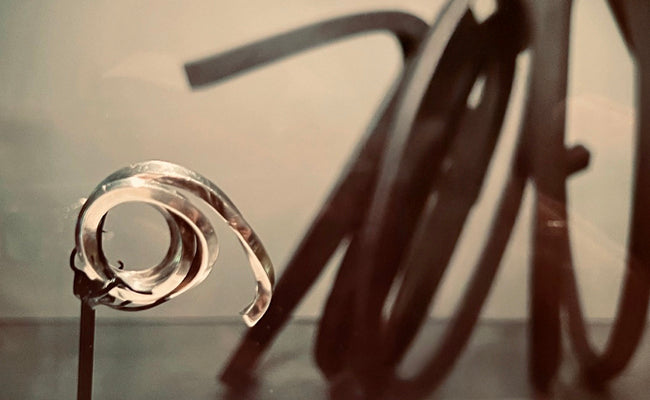
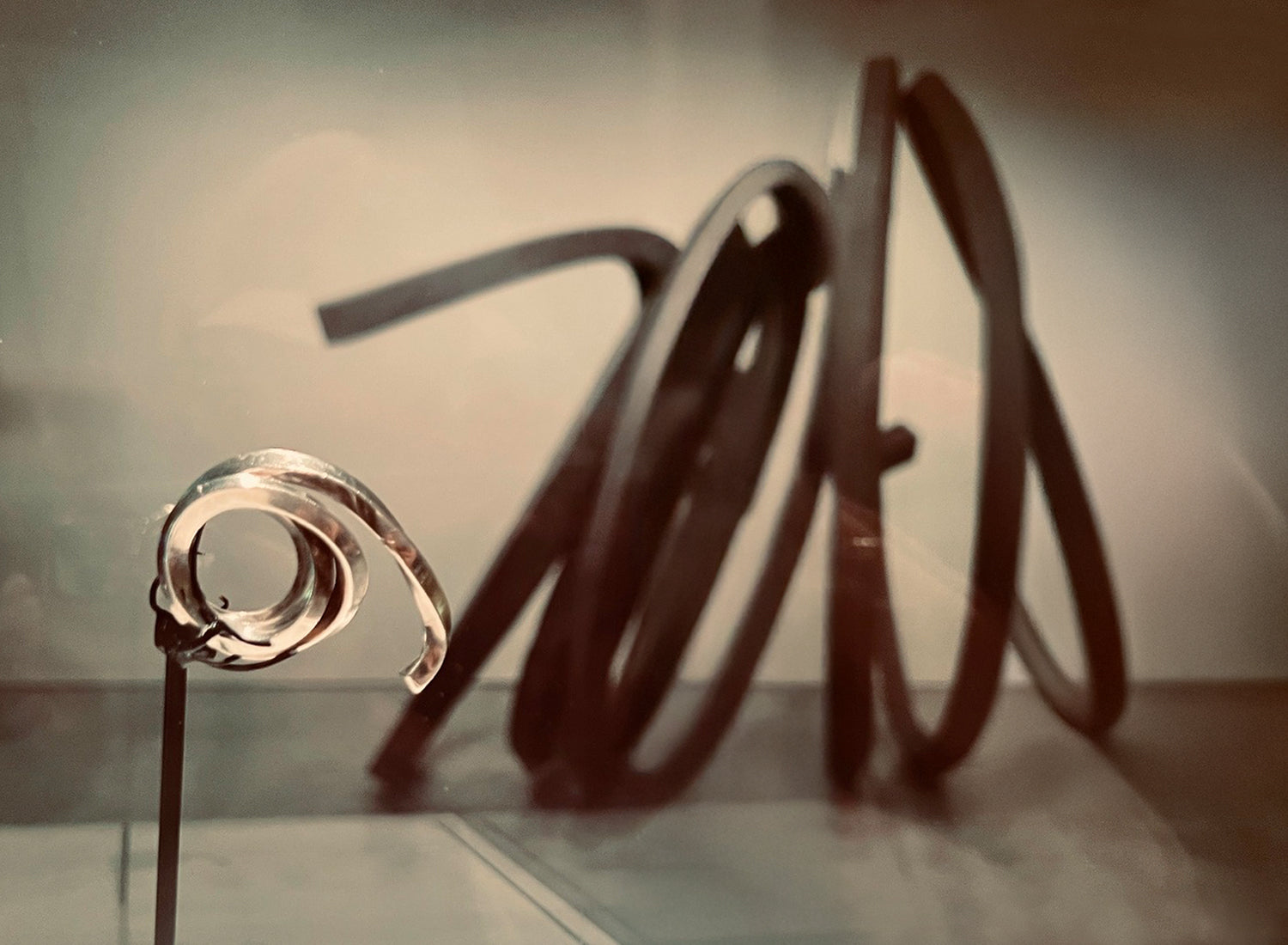
LEFT: VÁCLAV CIGLER EXPERIMENTAL JEWELRY (1965, 1967); CHROME-PLATED BRASS. RIGHT: VRATISLAV KAREL NOVÁK’S ECHO (1984), PHOTOGRAPHED BY PAVEL BAŇK. THE IMAGE CAPTURES JEWELRY NOT AS AN ISOLATED OBJECT, BUT IN DIALOGUE WITH THE HUMAN FIGURE, A RECURRING THEME IN THE MUSEUM’S EXPLORATION OF MODERN CZECH JEWELRY. PHOTOS: @ALLOYALIST
At some point I realized that I had been so focused on the things inside the cases that I hadn't really considered the largest object in the collection: the building itself.
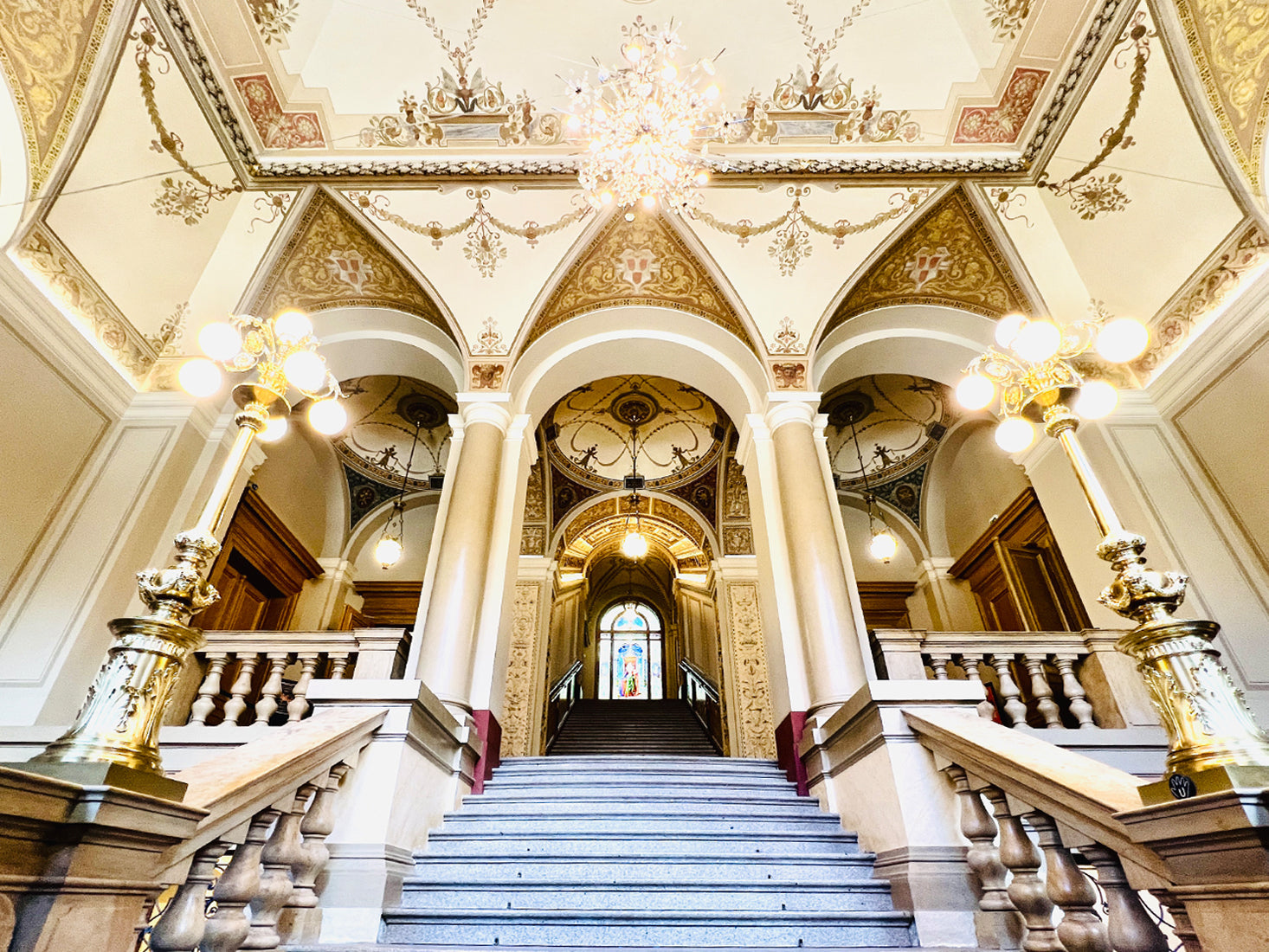
The Museum of Decorative Arts is housed in an extraordinary Neo-Renaissance building designed by Josef Schulz and constructed at the turn of the twentieth century. Schulz didn't simply design the exterior. He conceived the interiors and even the original exhibition and storage furniture. In that sense, the building was designed as a complete work - architecture, ornament, furniture and objects speaking to one another. And the decoration is about craft.
Look closely at the building's main façade and the museum begins telling you what it is about before you even walk through the door. Sculpted reliefs represent the decorative trades the museum was created to celebrate and preserve: weaving, lacemaking, glassmaking, stone carving, armour-making, bell-founding - and, particularly close to my heart, goldsmithing and jewelry-making. The building is quite literally decorated with the crafts whose objects it was built to hold.
Walking through it today, the architecture almost feels like an unintentional extension of Vita Aeterna.
Stone, carved ornament, painted ceilings, stained glass, woodwork, metalwork… the building itself has required conservation. It underwent a major restoration from 2014 to 2017, when its historic elements were restored while the museum was adapted for contemporary use.
The building has been repaired so that it can continue housing repaired things. There is something wonderfully circular about that.

From the walk to the museum and even before entering a gallery, there are layers of making, keeping, removing, rebuilding and preserving beneath your feet. Perhaps that is why the building felt so much like part of the exhibition to me. Vita Aeterna asks us to look closely enough at an object to see that survival is not passive. Things are built, altered, damaged, repaired and interpreted again.
The museum building has been through that process too. And so has the city around it.

When To Go and How to Get There
The Museum of Decorative Arts in Prague sits in Josefov, Prague’s historic Jewish Quarter, just steps from the Old Jewish Cemetery and across from the Rudolfinum - the building at the center of Jiří Weil’s Mendelssohn Is on the Roof. (Sode note: Mendelssohn’s statue was in fact removed from the Rudolfinum during the Nazi occupation, but survived and was eventually returned to the roof, where it stands today. The novel’s wonderfully dark episode involving the mistaken removal of Richard Wagner is fiction: there was never a Wagner statue on the Rudolfinum. That history makes the building across the street worth more than a passing glance...)
- Address: 17. listopadu 2, Prague 1. Josefov
- Getting There: It’s an easy walk from Old Town. The nearest Metro station is Staroměstská (Line A), with trams stopping there as well.
- Hours: Generally Tuesday–Sunday, 10 AM–8 PM; closed Mondays. Check the museum before visiting for holiday or exhibition-specific changes.
- Admission: General museum admission is CZK 350, with reduced admission available; children and young people under 18 enter free.
- Don't Skip the Building: Look up. The Neo-Renaissance building is part of the experience: carved stone, painted ceilings, architectural ornament and representations of historic crafts make it feel almost like another object in the collection.
- Currently on View: Vita Aeterna explores conservation and restoration and is scheduled to run through November 1, 2026.
My advice: leave yourself nowhere to be immediately afterward. This is the kind of museum that rewards wandering slowly, looking at the backs of things, reading the restoration notes and noticing the evidence of the hands that made them. Then step outside and keep walking through Josefov. In Prague, the line between the museum and the city can feel wonderfully thin.

Leave a comment
This site is protected by hCaptcha and the hCaptcha Privacy Policy and Terms of Service apply.